Tumblr
Tumblr [tumblr.com] is by far the best social media on the Internet.
Post types: text, image, video, audio, link, quote; it's actually rich text, so you can have up to 30 images in a single post, and place them wherever you want. You also have bold text, italic, you can choose different fonts, and different text colors. Additionally, you can place images in a grid layout. Tags on Tumblr are added in a separate box and can have spaces. This is the most freedom of expression in post-writing that you'll ever get from a social media on the Internet.
Privacy: a profile on Tumblr is called a "blog," and besides your primary blog, Tumblr lets you create as many "secondary" blogs as you want. Do you want to separate your personal and business profiles? Just create a secondary blog. No extra e-mail address or phone number needed. You can quickly switch before commenting on someone else's post. It's possible to hide a blog behind a password, but the security of this isn't very great since anyone who knows the password can see the posts. It's not possible to make a blog "private" in the sense of only accessible to your followers.
Communication: Tumblr has 4 different means of communication: you can reblog a post to your blog, allow you to add more words below it; you can talk on the chatbox attached to the post; and you can send an question to a blog if it allows users to ask questions (in some cases, you can also ask anonymously); and you can also send a direct message to a user to chat with them.
Content: Tumblr has many great photography and art blogs, science blogs, fan blogs, etc. This is all thanks to its secondary blog and reblogging system. Any user can create a secondary blog for a topic they care a lot about and start reblogging to that blog content of other blogs, creating a nexus of content that other users can follow. For example, if you are a fan of Hollow Knight, you can create a secondary blog where you repost Hollow Knight fan art and memes, and naturally other fans of Hollow Knight will start following you. Because your secondary blog is only for this purpose, it doesn't get mixed with posts of other games that you post on your primary blog. Although you can achieve similar things on many social media platforms, Tumblr makes the whole process extremely easy, which means you'll probably find one or two blogs related to your fandom on Tumblr.

Pinterest [pinterest.com] is another great social media, specially if you just want to look at pictures on the Internet. You'll find lots of photography, artwork, infographs, etc., posted on Pinterest.
Post types: on Pinterest, your posts are called "pins." The idea is that you "pin" images that you found on the Internet. You can create "boards" on Pinterest to categorize your pins. You can also "re-pin" a pin someone else posted to your boards or to your profile. Pins are mainly images, but Pinterest allows short videos as well nowadays. It seems it will only play one video per screen, so it's not as taxing on your attention. However, on mobile the screens are smaller, so videos are played more often in the app. There are no hashtags on Pinterest. When you create a post, you can pick a few categories for it from a fixed set of categories, but it's unclear how this information is really used.
Communication: Pinterest has comments on posts, but the comment system isn't very usable. By default, it sends notifications for all sorts of interactions on your posts, so you're likely to miss that someone commented on anything if you aren't paying attention.
Pitnerest has an extremely good recommendation algorithm. If you start pinning things that fit a certain category, your homepage will become full of the same sort of thing. For example, when I pinned some text effects I found on Pinterest, my homepage became full of text effects.
It's worth noting that Pinterest is particularly popular with the female public, much of its content being about fashion, hairstyling, makeup, home decor, crafts, etc. So at first the algorithm may recommend this sort of content. However, after you pin a few things that interest you the algorithm quickly realizes what you're looking for in the platform and starts displaying similar content.
Like Tumblr, Pinterest's strengths lies in empowering users to curate posts. Creating original content is a lot of effort compared to just creating a page that lists content created by other people that you found and liked. This can be useful as well if it relates to your profession. For example, if you are a designer looking for inspiration ("inspo"), a secondary blog on Tumblr or a board on Pinterest can serve the exact same purpose of collecting ideas to inspire you.

TikTok
TikTok [tiktok.com] is a very happy social media website with lots of short videos with music.
Post types: TikTok only allows short, vertical videos, around 10 to 15 seconds, mainly with some funny music in it. It also allows slightly longer videos around a few minutes, but doesn't support hour long videos. More specifically, TikTok is an app for smartphones that lets people record the video and post it to the platform, and they also have a website where you can access the content from desktop. You can also post vertical videos from the desktop without a smartphone if you want. Upon uploading a video, you can choose a song that will be played along with it. Posts are categorized by hashtag and by song. Consequently, it's very common for song-based memes to appear that can only exist on TikTok, e.g. people do something weird on video when the exact instant the lyrics of the song say something, and if you search for that song, you'll find dozens of people following the exact same pattern. I think it's very interesting that it has its own unique type of meme.
Region-lock: one demerit of TikTok is that its algorithm is region locked. When you create an account, it assigns the country you're accessing from to your account's profile and the only way to change that is by accessing from another country. This means if you are Brazilian like me, for example, you are only recommended videos posted by other Brazilians, and you never get recommendations posted by Americans or Europeans. I really don't like this. With the Internet, the other side of the planet is only a few centimeters away from me, except for TikTok, apparently, which won't let me see what are the most popular videos on the planet for some reason. This isn't even a restriction of language, it's purely geographical. You can still find videos posted by other countries if you search for it, but the algorithm doesn't recommend them to you automatically.
Okay Social Media
Besides the above, some other social media websites that I wouldn't say are the best, but are okay enough.
Youtube
Youtube [youtube.com] is a website where you can watch and post videos of any length.
Pros: it has an immense number of videos uploaded to it. All sorts of topics.
Cons: Youtube may feel suffocating because all the thumbnails are clickbait. When you upload a video, you have the choice to upload a custom thumbnail, which takes effort, or just use a frame of the video. I can't tell when was the last time I saw a thumbnail recommended to me that wasn't custom made. This means you never get recommended content by someone who just upload a video to Youtube. You only get recommended videos by people who are professional Youtubers, and their thumbnails are engineered to make you click on them. When the whole platform is filled entirely with this sort of content, it feels like everyone is begging you for your click, which doesn't make it a very comfortable platform to be in. While TikTok has a similar problem managing users' attention, the difference is that TikTok will promote a random video of a new user to hundreds of people, while Youtube simply never does that, so you rarely get recommended something that looks amateur but genuine.

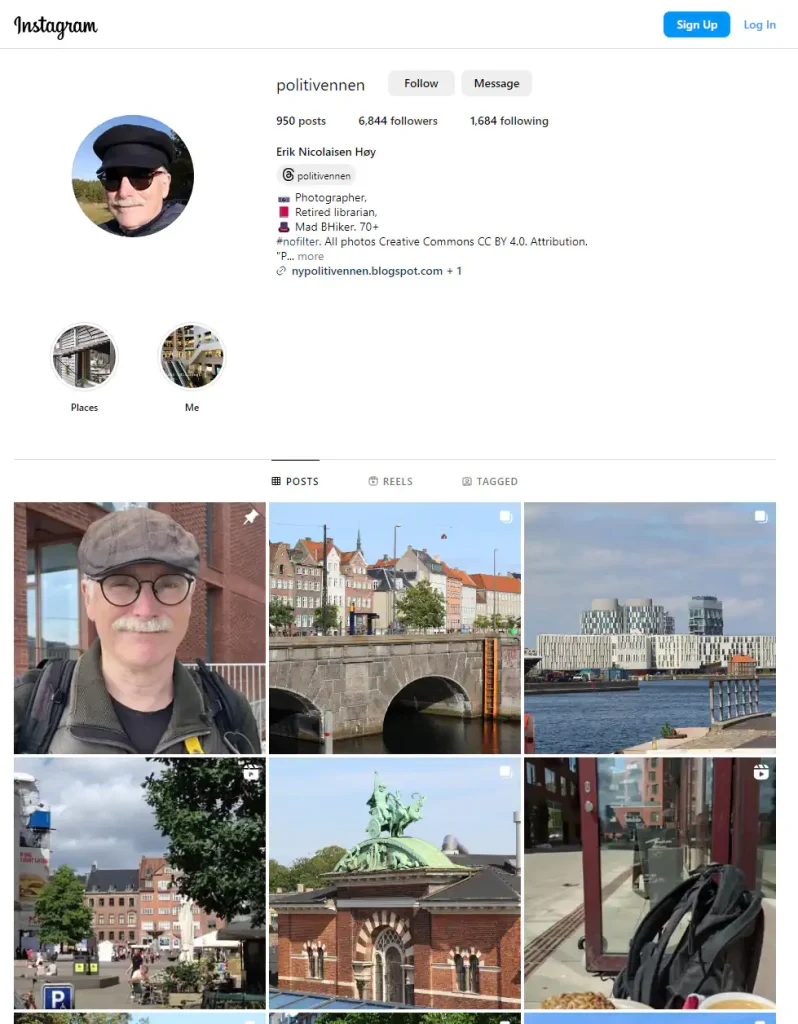
Instagram [instagram.com] is a social media primarily for posting images, photos, but that recently has become yet another TikTok clone, featuring more and more short vertical videos that it calls "reels."
Pros: Instagram's main advantage is its sheer size. There are many photographers, artists, and establishments whose only social media presence is an Instagram page, so it's not really possible to follow them from elsewhere. Instagram's advantage over TikTok is, ironically, that it allows photos to be posted instead of just videos, so there may be photographers on Instagram that can't post anything on TikTok. Some visual artists try to work around this limitation by posting the process on TikTok, revealing their final work at the end of the short video, but it's clear that it would be better if you could just post what you wanted to post without having to resort to these tricks.
Cons: because Instagram doesn't have curation blogs like Tumblr, users can only find the content they're looking for by searching through hashtags, but the amount of content displayed in those hashtags is severely limited and likely filtered. In other words, even if you post under a hashtag, it's unlikely that your post will be seen by anyone. Instead, most of the content users discover will be shown through recommended posts. Instagram seems to have a tendency to show "funny videos" in the recommendation posts, and I, personally, don't have seem to have the same sense of humor as the people creating these funny videos, so I don't like this system very much. Like TikTok, Instagram is also region locked.
Mastodon
Mastodon is a decentralized social media technology and also the name of its most popular instance, [mastodon.social].
Pros: the platform being decentralized is really interesting in regards to user freedom. There are unique strengths to this and very good reasons to want it. So far, no other platform actually provides it, since most of them are either not really decentralized in practice yet, or not popular enough to be usable at all.
Cons: there is no recommendation algorithm, so the only way to find content or be found is by using hashtags. Nobody warns you about this when you start posting, so it's very likely that many new users start posting and never got any interaction so they just gave up on the platform completely. Despite the platform being decentralized and theoretically spanning a lot of people, there really isn't anything fun being posted in it. It's not a good platform for viewing photos, it's not a good platform for reading text since there is character limit, it's not a very good platform for short videos. It's just a boring platform in general. The only thing it's good for is for sending people news and announcements and for arguing with people on the Internet. That's not fun.
Worst Social Media
These are social media websites I recommend you to avoid.
Reddit [reddit.com] is a platform that hosts comments of people who love hearing the sound of their own voice.
Pros: there is probably a user-moderated community for your hobby on Reddit, and you'll have a great time there for 30 minutes until you try to post anything, or you start seeing the patterns in what gets upvoted, or you start feeling some type of post is missing, or you get in trouble with a moderator. Old Reddit remains a great way to have long form text discussion on social media.
Cons: Redditors are very unfriendly people who are never happy and don't know what they want. Despite being a platform that allows users to express themselves in long text form, any expression you make there will be meet with offense because Redditors just get offended about everything. If you have an opinion, someone will downvote you for having that opinion, blissfully unaware of the anti-social atmosphere they are creating. Reddit's general stance against what it loosely labels "self promotion" pretty much ensures that no original original content is ever linked to by its author, as they promise to permanently ban you for it on your first offence. I'm pretty sure that this stance only benefits Reddit as a business, but moderators who are mere users uphold it nonetheless. Every community has a dozens of pages of rules that nobody is going to read but their very existence makes me not want to participate. How is "have common sense" not clear enough to be the only rule, when moderators can write "no trolling" as the 7th rule despite that being just as vague? A large number of users on Reddit are bots. If you use Reddit, you should assume almost every thread, question asked, and link shared was posted by a bot. Redditors generally won't notice this because they aren't really interested with talking to others, they only want to post their opinion on the Internet, so it doesn't matter to them if the thread was posted by a bot or not.

Bluesky
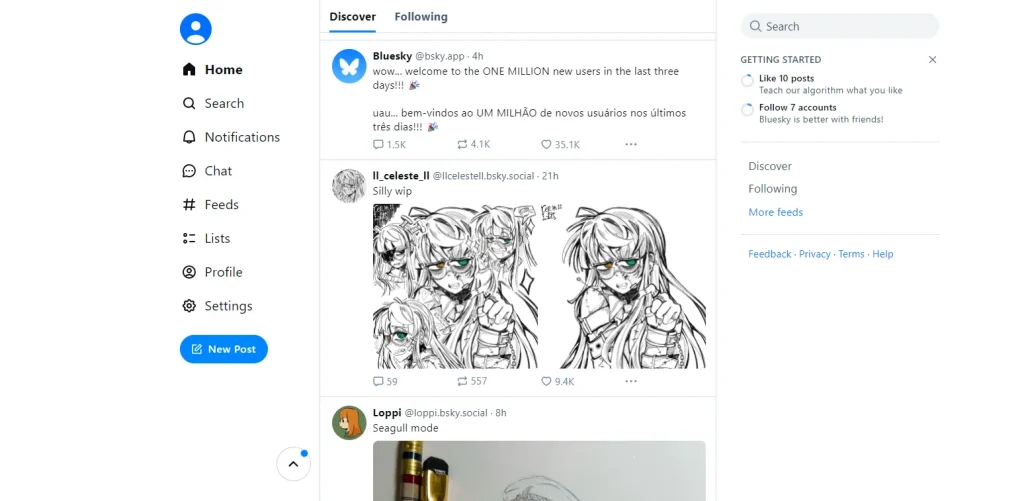
Bluesky [bsky.app] is pretty much like Mastodon.
Pros: there is a recommendation algorithm.
Cons: it keeps recommending news and drama instead of fun stuff, consequently, most profiles will start writing their opinions on it, making doomscrolling unavoidable no matter whom you follow. Also, it's not even really decentralized since everyone just uses one app. Bluesky has more potential than Mastodon, in my opinion, but currently it's just not a good platform at all, specially when you can just use Tumblr instead.
Twitter [twitter.com] is a social media website that is mainly about short text posts, called "tweets." While it used to be an okay social media in the past, after a charge in ownership it was sent downhill with numerously colossally bad management decisions, including rebranding the platform to "X" (you read that right, a single letter, "X").
Pros: Twitter, like Instagram, has its sheer size as its advantage. So long as some people insist on posting on Twitter instead of migrating to Tumblr, or other, lesser social media, that will remain true. Although X as a brand is terrible, the Twitter's iconic blue bird remains a recognizable icon to this day, even after the platform stopped using it as its mascot. Millions of businesses around the world have invested a lot of time and resources on Twitter, and, without comparable alternative, they can't just leave the platform, which means to get news and announcements from all sorts of accounts, Twitter remains an important platform. Personally, although I've never used Twitter a lot, I'm hoping that it returns to its former glory in the future, perhaps if it changes ownership again, and a new owner undoes the terrible policies that currently exist, it will stop being one of the worst social media on the Internet.
Cons: Twitter's recommendation algorithm is literally ads. It will only show posts that come from accounts that pay a subscription. These accounts have a blue checkmark on them. On most websites, and on Twitter itself previously, the checkmark means a user is "verified" in some sense. On Twitter, it just means they paid 8 dollars. On Tumblr, it also means that, because they implemented checkmarks in response to Twitter's policy change, but Tumblr is better because you can buy 20 checkmarks to place next to your name if you want, so everyone knows it doesn't mean anything. It's worth noting that I'm pretty sure there are regulations on ads that a platform has to follow, and I'm pretty sure Twitter isn't following any of them because the users aren't paying directly for ads, they're paying for a subscription, which boosts their posts' visibility, which sounds a lot like ads with extra steps to me, but somehow it isn't considered an ad. You can reply to a post on Twitter, but replies by paid users' appear on top of the list regardless of how many likes the post has. As anyone with half a brain would imagine, this means the whole platform is filled with bots. The bot pays $8 to get priority then spams on all popular posts, now their message is everywhere no matter how irrelevant the content they posted was. Twitter even lets paid users hide the checkmark so the bots can hide among normal users better. To follow non-popular users, or to just get notifications, the platform remains usable, but in that case you could achieve the same thing on Tumblr, Mastodon, Bluesky, and even Instagram as well, and you wouldn't have the problem of bots paying to spam content. If you decide to use Twitter, be wary of anyone who advises how to make money with cryptocurrencies, they're likely a spam bot.
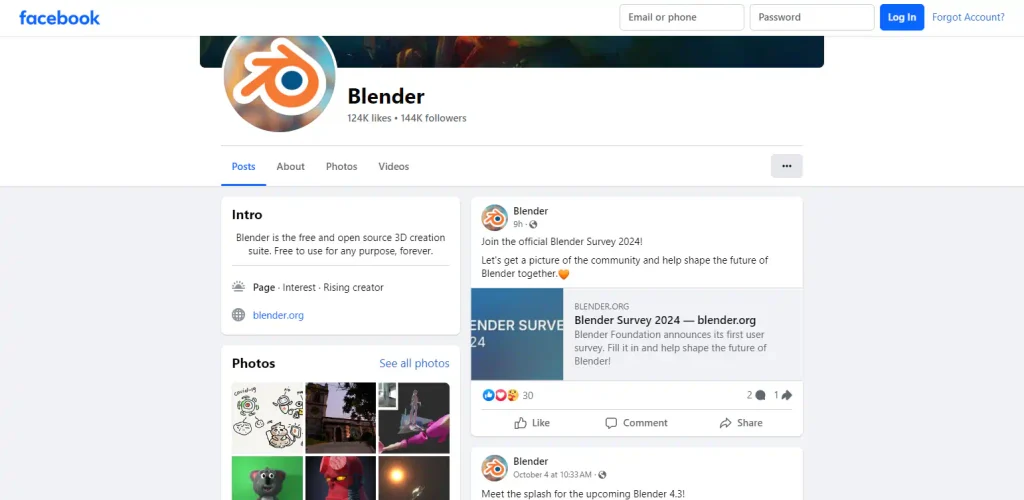
Facebook [facebook.com] is a social media website that has become a TikTok clone.
Pros: this is the most mainstream social media platform, so it has the most users of all. Everyone has Facebook. Facebook has policy that requires users to use their real name, and you can get banned for not following it, which improves the authenticity of the platform.
Cons: Facebook has a policy that requires users to use their real name, and that's a terrible idea. The Internet never forgets, so you really don't want everything you have ever written on the Internet to appear next to your real name. Always use a pseudonym for your privacy's sake, or you'll regret it. To be fair to Facebook, it does allow users to create alternative personas with pseudonyms, just like Tumblr's secondary blogs. However, it's still attached to your real name, so it doesn't feel like there is a lot of privacy in this. Facebook's Terms of Service don't allow you to create multiple accounts either, so you can't have one account for your real name and one for the pseudonym, it has to be both on the same account. I'm sure that lots of people have accidentally posted something from their real accounts that was supposed to be posted from the pseudonym or vice-versa because of this design. Additionally, Facebook nowadays is infested with short videos. Even though I'm browsing from desktop, every post is a short, tall video, and it's generally the same sort of content you see on reels on Instagram: funny videos, curiosities that waste 10 seconds of your time at the start telling you that you're going to see something amazing in order to improve their engagement metrics, that sort of thing. It's hard to imagine why would anyone use Facebook when TikTok has the same content. Facebook also has groups that you can join, which work like Tumblr's recently release feature: communities, or to Reddit's subreddits.
Imgur
Imgur [imgur.com] was Reddit's image hosting service that somehow became a social media website after adding its own comment system. For a while, it was pretty popular, but after Reddit became able to post images directly to the site, it started losing users, and now has become a ghost town. I assume turning into yet another TikTok clone didn't help.
Other Social Media
For reference, some other social media I have heard about, but that I haven't used enough to form an opinion of.
- Plurk, an older social media mainly popular in the east. Has a horizontal timeline, which is pretty neat.
- Fan Clubs, a forum trying to be a Reddit clone.
- Discuit, a Reddit clone.
- Tildes, a Reddit clone that shows up on Marginalia's tilde search by accident.
- Lemmy, a decentralized Fediverse-based Reddit clone.
- Mbin, another Fediverse Reddit clone.
- PieFed, yet another Fediverse Reddit clone.
- Threads, a Twitter clone that brings everything bad about Twitter and everything bad about Instagram together.
- LiveJournal [livejournal.com]. I'm not really sure what it is, but it exists.