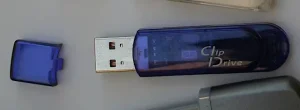
USB Flash Drive
The correct generic term for this device would be USB flash drive. That's because it is what it is. A USB flash drive is a "drive" in the computer that stores data in non-volatile flash memory, and connects to the computer through a USB port. All USB flash drives have these features.
Most Used Term
In terms of popularity, "thumb drive" is more popular in English nowadays. This may vary from region to region. For example, here in Brazil they are called "pen drives" and if someone called it a "thumb drive" nobody would understand it because we don't speak English. In fact, you can have people who use pen drives and they don't even know what a "pen" is. And this is basic English that is taught in the public school curriculum.
For reference, usage data from Google Books Ngram Viewer on the English corpus:
Observe how "USB flash drive" used to be the most popular term in the past, but nowadays "thumb drive" is the most common term. "Memory stick" and "mobile disk" had usage before the USB flash drives were first produced because these terms also refer to other technologies. The 2022 ranking is:
- Thumb drive.
- Memory stick (because it refers to other things).
- USB stick (less than half of thumb drive's usage).
- Pen drive (usage slowly growing).
- USB flash drive (almost same usage as pen drive but declining).
- USB flash disk, DiskOnKey, Jumpdrive, mobile disk (tied with insignificant usage).
Product Names
The main reason for the USB flash drive to have so many names is that the names are actually product names. Around the year 2000, there were many hardware companies that were creating their own small portable devices that stored data in flash memory and connected to the PC using USB. Each one of them had their own name, and sometimes even a patent and registered trademark.
Observation: many of these trademarks don't have spaces in their official trademark registration, which is interesting because when they are used as generic terms they often get spaces.
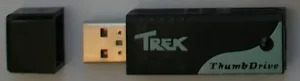
ThumbDrive
One of the first product names was the ThumbDrive, invented by Henn Tan at a company called Trek 2000. It seems it has never been settled whether this was the first USB flash drive ever invented, since some similar products were created around the same time, and it wasn't a particularly difficult thing to create given its components had already been invented by other people.
I haven't been able to confirm why it's called a "thumb" drive specifically, so I speculate it's because it's small, the size of your thumb, much smaller than the contemporary floppy disk.
But the thumb drive, with its flash memory and USB interface, was hardly a completely novel invention. Tan did not invent flash memory, which was the brainchild of Toshiba engineer Fujio Masuoka in 1980. Nor did he invent the USB port, which had been around since 1996. What was novel was the combination of the USB with flash memory plus a controller and appropriate firmware, all sealed into a plastic case to make a marketable consumer product.
https://spectrum.ieee.org/thumb-drive (accessed 2025-01-15)

DiskonKey
The DiskonKey was product patented by M-Systems and sold by IBM.
The term "disk" is used in the same sense as "drive," so even though this device has neither an actual disk nor an actual drive, it somehow got named both things.
- Why is the "Disk" Called "Disk" if it isn't a Disk?
- Why Drives are Called "Drives" if They Aren't Drives?
I haven't been able to confirm why it's called disk on "key" specifically, so I speculate, considering its design, that it's because it's designed to look like a key that you insert in a keyhole (the USB port), or because the ring looks like a keyring and could perhaps be used with a keychain.
In April 1999, the Israeli company M-Systems filed a patent application titled “Architecture for a Universal Serial Bus-based PC flash disk.” This was granted to Amir Ban, Dov Moran, and Oron Ogdan in November 2000. In 2000, IBM began selling M-Systems’ 8-MB storage devices in the United States under the less-than-memorable name DiskOnKey. IBM has its own claim to the invention of an aspect of the device, based on a year-2000 confidential internal report written by one of its employees, Shimon Shmueli.
https://spectrum.ieee.org/thumb-drive (accessed 2025-01-15)


Pen Drive
The Pen Drive was a product trademarked by Phison. Although they don't claim to have invented the USB flash drive, they do claim to have "invented the first single-chip USB flash controller."
I haven't been able to confirm why it's called the "pen" drive specifically, so I speculate it's because it has a "cap" like a pen. It's worth noting that there is a differently pen-like USB flash drive that you press a button on one side to make the USB plug appear on the other side like a pen, but that's not the design of THE "pen drive," it's a completely different product by someone else entirely, so that wouldn't be the reason.
Mr. Pua: [...] Phison has never claimed to be the inventor of the pendrive. What I insist on that, what our Phison team achieved, was to come up with the USB System on Chip, (or SoC), a multichip integrated to a single chip, cost-down and in slim size, turning it into a popular solution on the market. In other words, we invented the first single-chip USB flash controller. Moreover, “pendrive” is actually a registered trademark of Phison and www.pendrive.com a registered website by Phison.
K. S. Pua - The Engineer Behind Pen Drive [https://www.crazyengineers.com/founders-circuit/ks-pua-inventor-of-pen-drive] (accessed 2025-01-15)
Note: Mr. Pua spells it "pendrive" but this trademark actually has a space, "pen drive," and you can even see it in its logomark.

JumpDrive
JumpDrive was trademark owned by Lexar (which was acquired by Longsys in 2017).
I haven't been able to confirm why it's called a "jump" drive specifically. I don't speculate because honestly I haven't the faintest idea about what is "jump" about this.

Mobile Disk
Mobile Disk is a product name by TwinMOS.
Get it? Because it's technically a disk and it's technically mobile: mobile disk! I actually love this name. It sounds so fun. Much better than "jump drive." You know what we need? A popularity contest for the coolest USB flash drive name to settle this once and for all. If I were a Youtuber I'd probably be making a Youtube video right now titled "Ranking USB Flash Drive Names" in that S-A-B-C-D-E-F ranking meme format. It's guaranteed a million views. Mobile disk, of course, is an S-rank.
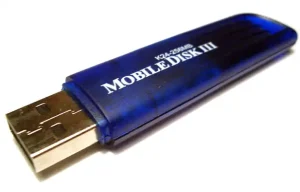

USB Flash Disk
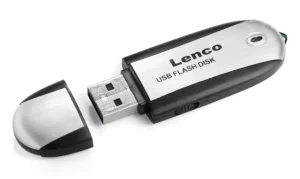
I found some products that were labelled "USB flash disks." Intriguingly, I haven't found an image yet of a USB flash drive that actually says "USB flash drive" on it.
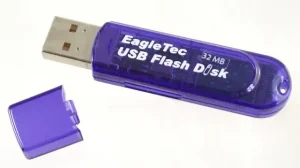

USB Stick
Since USB flash drives look like sticks that you stick into a USB port, it makes sense that they would be called "USB sticks" as well.


Memory Stick
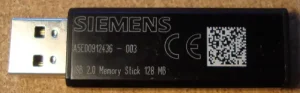
A USB still is technically also a memory stick, so I guess you could call it that. It's worth noting that "memory stick" often means other things, not USB sticks specifically. For example, you can call a RAM chip a memory stick because it's a stick of RAM memory.

ClipDrive
ClipDrive seems to be a product by a Japanese company, if I'm not mistaken. I'm not sure if anyone actually calls USB sticks "clip drives," specially if this is a trademark that is only or mainly used in Japan, and was only used over a decade ago, but I'm including it here anyway because it has the word "drive" in it.